LLM Reasoning & Agents
SPRINT: Teaching Reasoning Models to Think in Parallel
An overview of SPRINT, a framework that teaches reasoning models to identify independent subtasks and execute them in parallel.
Large reasoning models have become increasingly capable of solving complex problems. However, there is an inherent inefficiency in how they reason: they generate long chains of thought, one token after another.
Consider solving a complex mathematical problem. You might need to calculate several independent expressions, explore alternative approaches, verify intermediate results, and eventually combine everything into a final answer.
A conventional reasoning model performs much of this work sequentially. Even when two calculations are completely independent, the model may process one before moving to the other.
But why should independent tasks wait for each other?
This is the central question behind SPRINT (Enabling Interleaved Planning and Parallelized Execution in Reasoning Models).
The paper proposes a framework that combines sequential reasoning with parallel execution. Instead of generating one long reasoning trajectory, the model learns to identify independent subtasks, delegate them to executors, and combine their results.
SPRINT has two major components:
- A training pipeline that teaches a reasoning model to identify parallelizable tasks.
- An inference framework that uses a planner and multiple executors to perform those tasks concurrently.
Let's understand how each works.
1. Training Pipeline: Teaching a Model to Think in Parallel
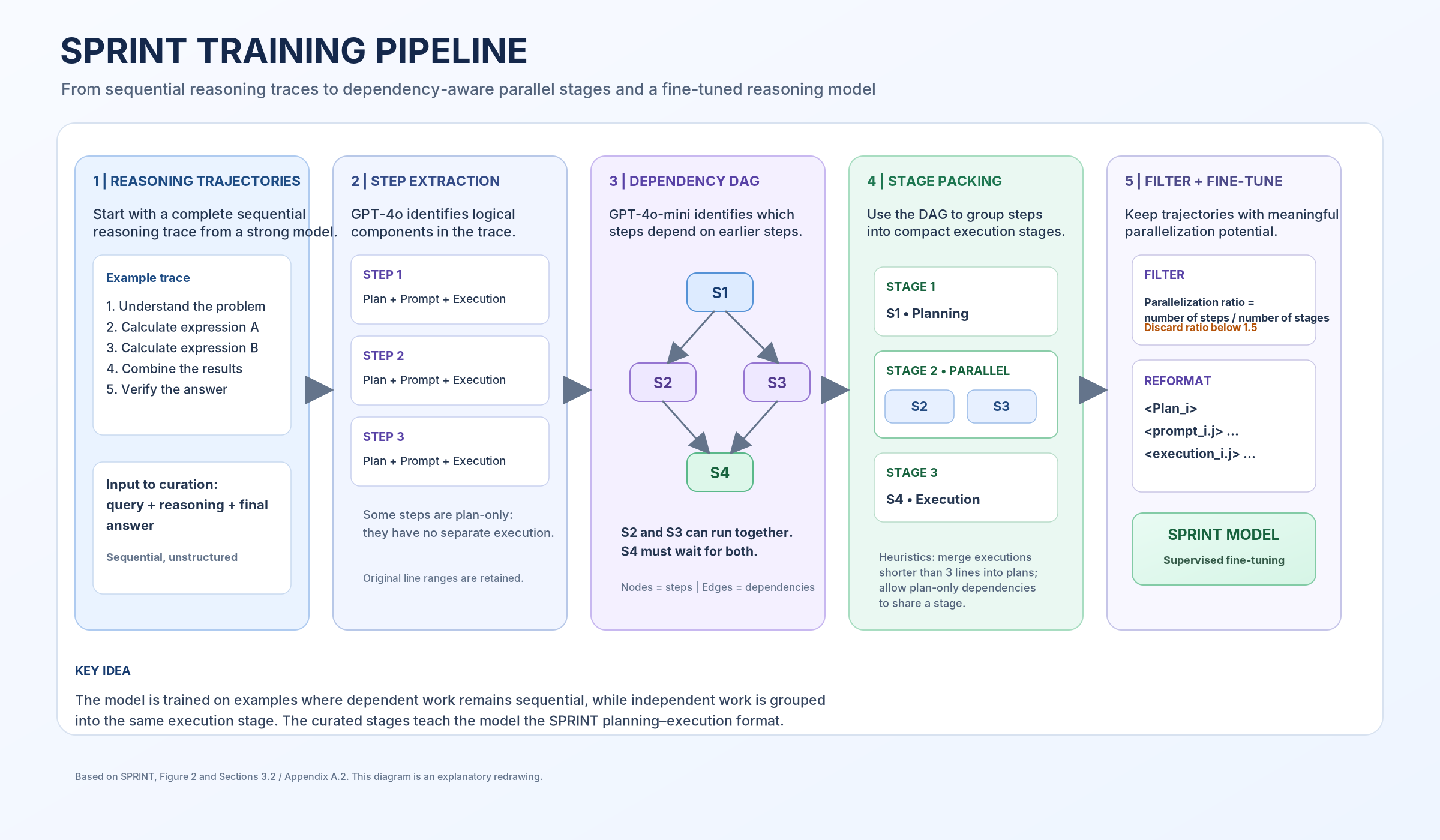
Figure 1: SPRINT's training pipeline — transforming sequential reasoning trajectories into parallel execution stages. Before expecting a model to identify parallelizable tasks, we first need to teach it what parallelizable reasoning looks like.
The authors approach this by taking existing reasoning trajectories and restructuring them into parallel execution stages.
Step 1: Start with sequential reasoning
The process begins with DeepSeek-R1, which generates detailed reasoning trajectories for mathematical problems.
A typical trajectory contains several types of reasoning:
- Understanding the problem and identifying a strategy.
- Performing calculations.
- Verifying previous results.
- Exploring alternative approaches.
- Comparing different solutions.
All these activities are originally embedded in one long, sequential chain of thought.
The challenge is to identify which parts represent independent tasks and which depend on earlier results.
Step 2: Extract planning and execution components
The authors use GPT-4o to decompose each reasoning trajectory into logical components.
Each component is divided into:
- Plan: What needs to be done?
- Prompt: What specific task should be delegated?
- Execution: How was the task actually performed?
- Comment: What did the model conclude about the execution?
An important distinction is that a logical component is not necessarily a single mathematical operation. It can represent a larger activity, such as verifying a previous calculation or exploring an alternative solution.
Some components contain planning without an explicit execution. These are called plan-only steps.
The result is a sequential reasoning trajectory reorganized into smaller, structured components.
Step 3: Identify dependencies using a DAG
Now comes the critical part.
Having separate components does not automatically make them independent. Some components require the results of others.
To identify these relationships, the authors use GPT-4o-mini to examine the extracted components and construct a Directed Acyclic Graph (DAG).
Each node represents a reasoning component, while directed edges represent dependencies.
For example, suppose we have:
- Step A: Understand the problem.
- Step B: Calculate expression 1.
- Step C: Calculate expression 2.
- Step D: Combine the results.
The dependency graph looks like this:
A → B → D
A → C → D
Steps B and C both depend on A, but neither depends on the other. Therefore, they can execute concurrently.
Step D must wait for both.
This graph provides the dependency structure needed to reorganize the original reasoning trajectory.
Step 4: Pack independent components into stages
With the DAG available, the authors assign components to execution stages.
The objective is to minimize sequential stages while respecting dependencies.
They introduce two optimization heuristics:
First, if an execution contains fewer than three lines, it is merged into its corresponding plan. This avoids unnecessary executor calls for trivial tasks and teaches the planner to handle simple operations itself.
Second, when a component depends on a plan-only component, its planning can sometimes be merged into the same planning stage. This avoids waiting for execution results that are not actually required.
The resulting dataset groups independent tasks into compact stages.
For example:
- Stage 1: Understand the problem.
- Stage 2: Calculate expressions 1 and 2 concurrently.
- Stage 3: Combine the results.
The original sequential trajectory has now been transformed into a sequence of planning and parallel execution stages.
Step 5: Fine-tune the reasoning model
Finally, the authors reformat these packed trajectories into structured training examples and perform Supervised Fine-Tuning (SFT).
The model learns how to generate plans, formulate executor prompts, organize tasks into stages, and incorporate execution results.
The authors initially experiment with LoRA and QLoRA but find that LoRA does not adequately teach the required response format, so they move to full fine-tuning.
They start with 6,000 reasoning trajectories and obtain approximately 1,700 curated training examples.
The result is a SPRINT fine-tuned reasoning model that has learned to structure its reasoning into parallelizable tasks.
2. Inference Framework: Using the Learned Ability
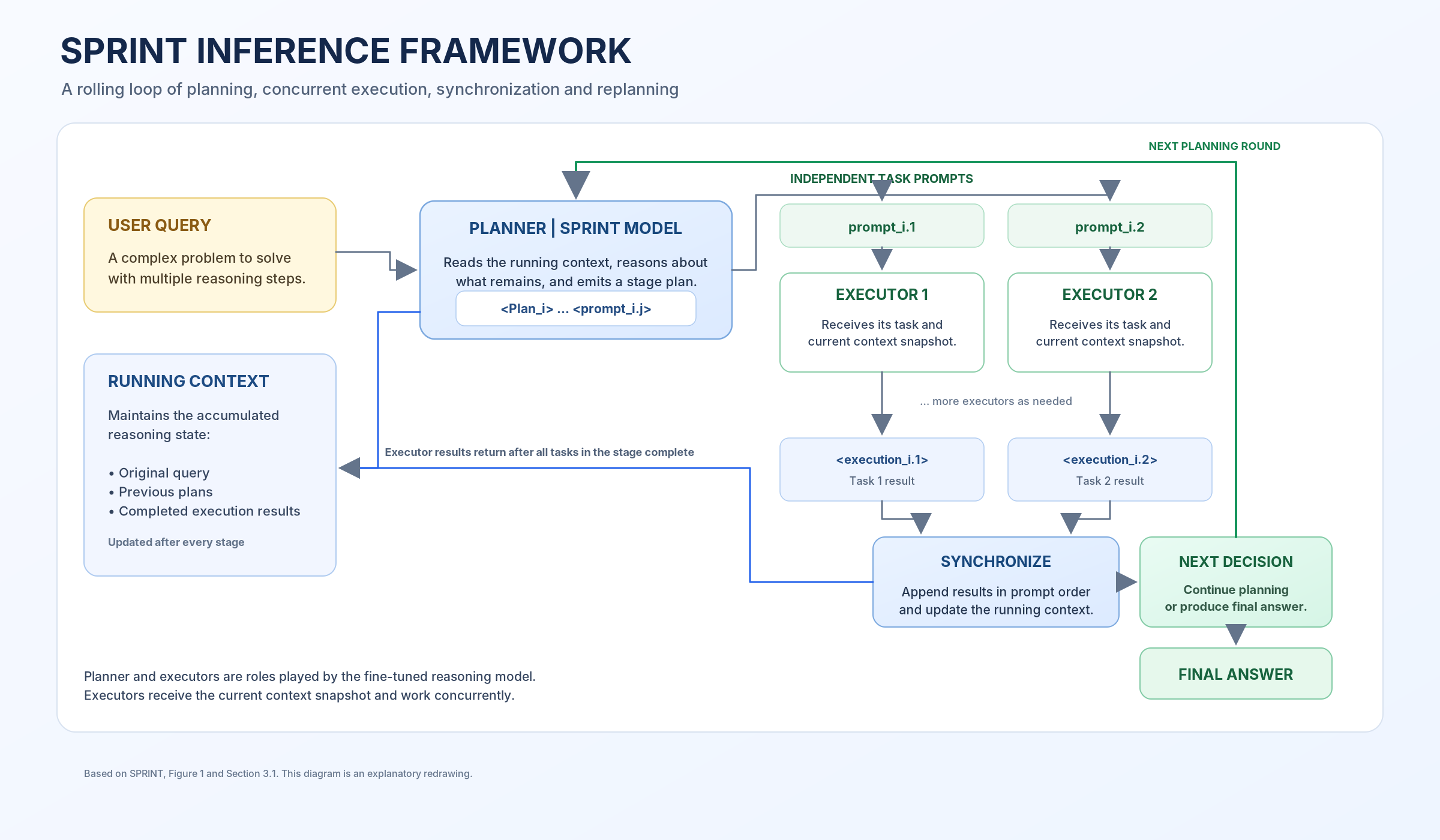
Training teaches the model how to organize reasoning for parallel execution. Inference is where that capability is actually used.
SPRINT introduces two conceptual roles:
- A planner.
- A pool of executors.
Importantly, these roles use the same fine-tuned model, invoked with different contexts and instructions.
Let's follow what happens when a user submits a question.
Step 1: The planner receives the query
The planner receives the original question along with the cumulative context.
This context contains previous plans and execution results.
Rather than immediately solving the entire problem, the planner reasons about what needs to happen next.
It generates a planning stage containing executor prompts.
For example:
<Plan_1>

We need to calculate two independent values.

<prompt_1.1>
Calculate the first expression.
</prompt_1.1>

<prompt_1.2>
Calculate the second expression.
</prompt_1.2>

</Plan_1>
An important detail is that the planner can generate intermediate reasoning before delegating work.
When an executor prompt is completed, the orchestration system initiates the corresponding execution using the current context snapshot.
Step 2: Multiple executors work concurrently
Each executor receives its assigned prompt and the relevant context, including the original question, previous execution results, and the current plan up to its own prompt.
The executors independently generate reasoning trajectories to complete their assigned tasks.
Executor 1 calculates the first expression while Executor 2 calculates the second.
Neither needs to wait for the other.
This is where SPRINT reduces sequential reasoning time: independent tasks are processed simultaneously rather than one after another.
Step 3: Synchronize the results
Once all executors complete their tasks, their outputs are appended to the cumulative context.
SPRINT uses structured tags to associate each result with its corresponding prompt.
For example:
<execution_1.1>
Result of the first expression.
</execution_1.1>

<execution_1.2>
Result of the second expression.
</execution_1.2>
The results are added in the same order as their original prompts.
This process is called syncing.
Step 4: The planner decides what happens next
The updated cumulative context is sent back to the planner.
Now the planner has access to both execution results.
It can decide whether another stage is necessary or whether sufficient information is available to produce the final answer.
Suppose the two calculations were only intermediate steps. The planner might now generate another task to combine their results.
The process repeats:
Planning → Parallel execution → Synchronization → Planning again.
Eventually, the planner terminates the reasoning process and produces the final answer.
This is why the authors call the approach interleaved planning and parallel execution. Planning and execution alternate rather than requiring the entire problem to be decomposed upfront.
Bringing the Two Components Together
The two components serve different purposes.
The training pipeline teaches the model how to structure reasoning into dependent and independent components. It transforms existing sequential reasoning trajectories into DAG-based parallel execution demonstrations and uses them for supervised fine-tuning.
The inference framework uses this learned behaviour to dynamically generate tasks, execute independent ones concurrently, and incorporate their results into subsequent planning.
There is an important distinction worth remembering: the DAG is explicitly constructed during offline training-data curation using GPT-4o-mini. At inference, the planner is expected to identify independent tasks based on its learned capabilities; the paper does not describe a separate formal DAG validator at runtime.
Ultimately, SPRINT is not trying to eliminate sequential reasoning. Some reasoning steps genuinely depend on earlier results.
Instead, it tries to eliminate unnecessary waiting between independent tasks.
The central idea is simple: preserve sequential reasoning where dependencies exist, but exploit parallel execution wherever dependencies do not.